stated
The Spiral Architecture
The Spiral Architecture is the ground beneath all of my work. It grew from a practical question that has accompanied me through complex systems, companies, family and care: how can a living whole remain coherent without asking the people or parts within it to surrender their freedom?

The question
What underlying architecture allows a complex living system to remain coherent while its individual parts remain free?
The grammar
- Z — the Stillpoint
- Axis
- Relationship
- Emergence
- Form
The Spiral Framework gives this architecture its grammar. Its five elements are not stages to complete, nor a method for turning different forms of life into versions of the same thing. A person is not a company. A family is not a technology. A piece of land is not an organisation.
Yet within each of them, a similar difficulty can arise: the structures surrounding life cease to serve the life within them. Decisions become detached from their purpose, relationships become extractive, and the parts begin to lose their connection with the whole.
The Framework offers a way of seeing where this has happened: where stillness has been lost, where the axis has been forgotten, how the parts are relating, what is beginning to emerge between them, and what kind of form those relationships are creating.
The axis is not a central authority controlling the whole. It is the stable orientation that allows the whole to recognise what it belongs to. Form is the expression that orientation takes under actual conditions.
Because conditions change, form must be free to change with them. What matters is whether the new form remains in relationship with the axis and continues to serve the life of the whole.
The Spiral Architecture is not a belief system, a personality model or a formula for fixing people. It is a working framework, and its value has to be tested where life actually happens. Does it help us see more clearly? Does it preserve agency? Can it hold difference without allowing the whole to fragment? Does the form serve life—or has life begun to serve the form?
“The axis is stable. The form is free.”
The full breath
Two movements, one spiral.
Inward
The return
Much of the Spiral work so far has been about coming back to yourself: stepping out of the noise, pressure, roles and habits that can pull you away from what you know and feel.
The Spiral Handbook accompanies this return. It begins with a very human question: how do I find my way back to myself when life has become too loud, too fast or too full?
Outward
Into form
Coming back to yourself is not the end of the Spiral. We return to the centre so that we can meet life from there.
The question now changes: how can something move from an inner knowing into the world without losing its coherence as it passes through relationship, uncertainty and change?
Relationship becomes essential because very little of importance is created alone. What begins within one person must eventually meet other people, different needs, real conditions and the freedom of everyone involved.
The inward spiral · nine stations
The return to Zero Point
The threshold
The inward movement often begins quietly. Nothing dramatic needs to happen. You simply start to notice that a way of living, working or relating which once made sense no longer feels right.
From the outside, everything may still look perfectly fine. Yet keeping it all going begins to cost you more of yourself than you are willing to lose.
Descent
Descent begins when you stop trying to rise above everything and turn towards what has been neglected.
You may meet grief you did not have time to feel, anger you learned to hide, needs you dismissed, or parts of yourself you set aside in order to cope, belong or keep life moving.
The purpose is not to remain there. It is to bring back what was left behind, so that you can move forward with more of yourself present.
The body speaks
The body often notices strain before the mind is ready to name it.
It may appear as a tight jaw, a restless night, a heaviness that returns before certain meetings, or the unexpected relief you feel when a decision is finally spoken aloud.
None of these responses gives you the whole answer. But they are worth noticing. They may be telling you that something needs your attention.
Reading the field
We all know what it is like to walk into a room and immediately sense that something has shifted, even when nobody has said a word.
Reading the field means paying attention to what is happening around and between people: what is being said, what is being avoided, where the pressure sits and how the situation changes when someone enters or leaves.
The first feeling is not always the final truth. The practice is to notice what you are picking up before deciding what it means.
The body as navigator
The body can help us find our way, but one physical response should never be treated as an unquestionable command.
Tightness may be a warning, or it may be the discomfort of meeting something unfamiliar. A feeling of openness may be a genuine yes, or simply the relief of escaping something difficult.
Discernment comes from listening over time and allowing the body, the facts, our experience and honest reflection to speak to one another.
Silence and self-sourcing
Silence gives us enough room to hear our own response before reaching for everybody else’s opinion.
Self-sourcing does not mean doing everything alone or refusing advice. It means that support can help you without replacing you. Other people may offer knowledge, care and perspective, while you remain responsible for recognising what is true and possible in your own life.
Inner authority is not certainty. It is the ability to listen to others without losing contact with yourself.
Breath as signal
Before using the breath to calm ourselves, we can notice what it is already doing.
Are you holding it while somebody speaks? Does it become shallow when you are about to agree to something you do not want? Does a full breath return when you finally tell the truth?
The breath does not make the decision for you. It gives you another piece of information—and sometimes the pause between one breath and the next is enough to stop an automatic reaction from becoming an answer.
The Gap
Sometimes the old answer stops working before a new one has appeared.
The methods that usually help may no longer help. The body may feel quiet or confusing. You may know that you cannot return to the life you had, while having no clear picture of what comes next.
This is the Gap. It can feel empty, uncertain and deeply uncomfortable, but it does not need to be filled immediately. Something old is loosening, and something new is not yet ready.
The work here is simple, although not always easy: do not abandon yourself because you do not yet have an answer.
Stay with yourself in the Gap.
Zero Point
Beneath the pressure to decide, explain or act, there can be a moment in which nothing needs to be solved immediately.
This is Zero Point: not a permanent state of peace, but a place of inner contact. You are still inside your life, with all its uncertainty and responsibility, but you are no longer being pulled in every direction at once.
You do not arrive there once and remain there forever. You return whenever you need to remember what is yours, what matters and what the next honest movement may be.
Arrival is not the end of the Spiral. It is where movement can change direction.
- Going in circlesMeeting the same pattern again without allowing what you have learned to change your response.
- Pretending to be calmLooking composed while fear, pressure or conflict remain unspoken.
- Trying harderAdding more effort when the way you have been moving no longer works.
- DisappearingCalling it silence when you have actually withdrawn from yourself, other people or life.
- Controlling the breathTrying to regulate the breath before listening to what it may be showing you.
- Rushing to fill the GapGrabbing the next answer, method or identity because uncertainty is difficult to bear.
Where the return can go wrong
“There is always a gap when we walk through a hinge, as we transform from the old to the new.”
The Gap is the turning point on the way in. Release is the turning point on the way out. Both ask us to stop forcing what comes next.
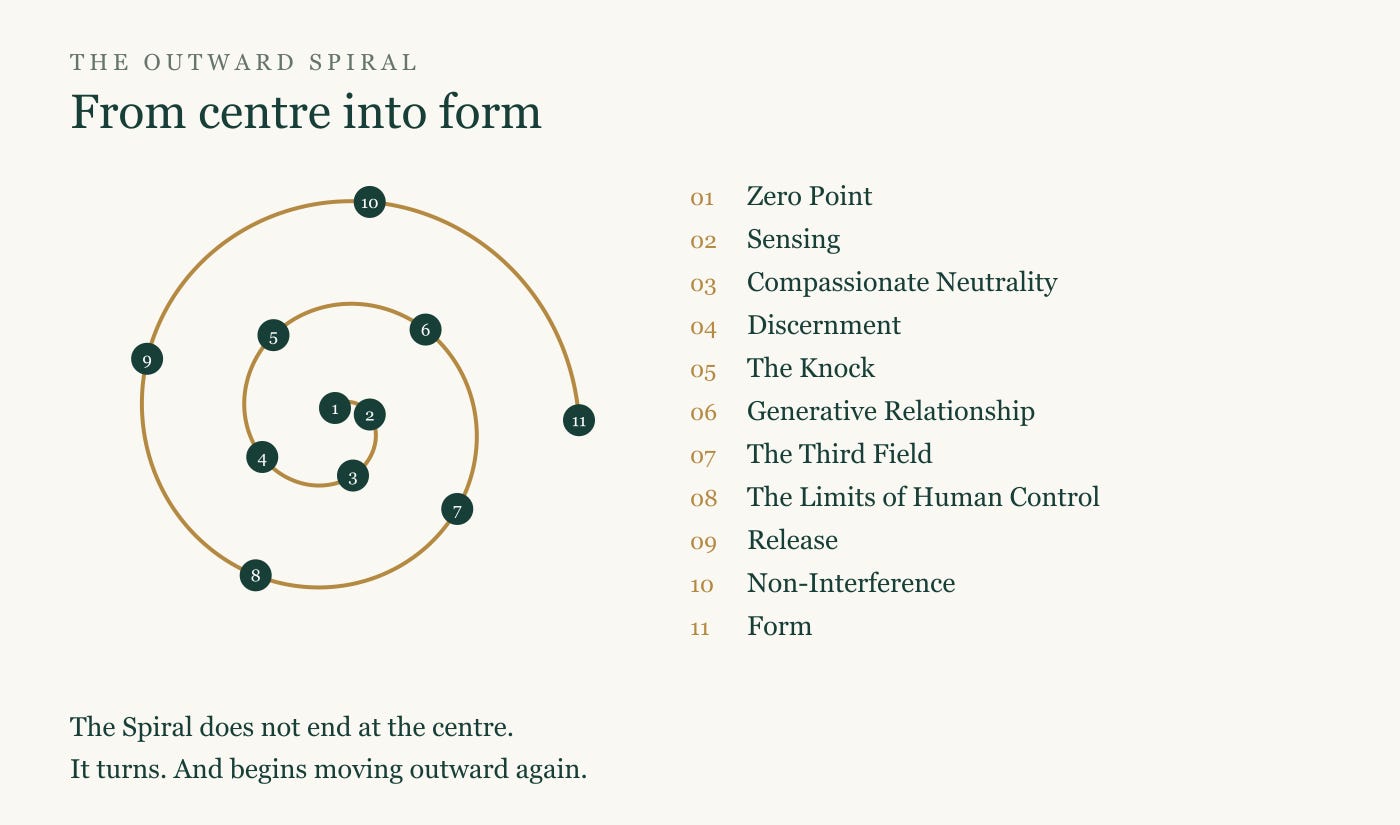
The outward spiral · eleven stations
From Zero Point to form
Zero Point
The outward movement begins from a stable centre—not from urgency, fear or the need to force a particular outcome.
This does not mean that you feel perfectly calm or already know what to do. It means that you are present enough to meet what is here without immediately being swept away by it.
From Zero Point, difference does not automatically become threat, and possibility does not immediately become obligation.
Sensing
From this place, you may begin to notice different possibilities: a conversation that wants to happen, a direction worth exploring, an idea that keeps returning, or a future that could become possible.
Noticing something does not mean that you must pursue it.
You can allow a possibility to exist without immediately entering it, naming it, announcing it or building your life around it.
Compassionate neutrality
Compassionate neutrality means being present to what you perceive without being consumed by it.
It is not coldness or emotional distance. It is the ability to care without absorbing everything, rushing to rescue, or losing the centre from which your care arises.
The other person or situation is allowed to remain itself. You are allowed to remain yourself.
Discernment
Discernment asks whether this is something you are meant to approach.
The body may offer part of the answer, but not all of it. Tightness may be a warning or simply the discomfort of something new. Openness may be recognition or the relief of avoiding a harder responsibility.
So we pause. We listen to the body, look at the facts, consider the consequences and allow the first reaction to settle.
Then we ask: this one? Not this one? Not now? Is there a genuine yes?
The knock
A possibility becomes relational when we approach the other.
Until then, it exists only within us. We may sense potential, feel a connection or believe that something meaningful could be created, but we cannot decide what the relationship means on behalf of somebody else.
We knock. We ask. We make an offer.
The other remains free to open the door, decline or answer in a way we did not expect. A shared field begins only when participation is chosen by everyone involved.
Generative relationship
Not every relationship is generative. People and systems can compete, absorb one another, compromise until neither remains whole, or cooperate without creating anything new.
A generative relationship has a different quality:
Both remain whole. Neither bends. Both expand.
This does not mean that neither participant changes. A truly generative relationship may change everyone involved. It means that nobody is required to abandon their axis, surrender their identity or become smaller in order for the relationship to continue.
Difference remains. Wholeness remains. And because of the relationship, more becomes possible.
The third field
Sometimes a relationship begins to produce something that neither participant could have created alone.
It may be a new understanding, a solution, a piece of work, a capability, a structure or a direction that only became visible through the meeting.
This is the third field. It does not belong entirely to either participant, and it is not one person’s vision imposed upon the other. It emerges between them.
The relationship itself has generated new capacity.
The limits of human control
When something promising begins to emerge, the natural temptation is to seize it: define it, announce it, plan every stage and force it to arrive on schedule.
But no participant can see the whole relational field. We do not know every conversation, delay, person, decision or change through which an emerging possibility may eventually find its form.
Our contribution is real, but it is not the whole.
Recognising that limit is not failure. It is the beginning of a more precise form of participation.
Release
Release begins when we recognise the boundary of our part.
We do what belongs to us, but stop trying to perform everybody else’s role, control every response or carry the entire outcome alone.
In my own life, I experience this as handing the larger orchestration back to Source. Whatever language another person might use, the practical boundary remains the same:
I participate. I do not possess.
Release does not erase the human contribution. It releases the claim to authorship of the whole.
I have done what is mine. Now I give the rest back.
Non-interference
After release, there may be a period in which nothing visible happens.
Non-interference does not mean abandoning what has begun, neglecting a responsibility or pretending not to care. It means remaining available without forcing movement simply because waiting makes us uncomfortable.
We allow other people to make their own choices. We allow events to develop. We continue living rather than gripping the possibility until it becomes lifeless.
The relationship remains alive even when it is quiet.
Form
Eventually, something may become real and visible: a conversation, an invitation, a person, a decision, a structure, a place, a technology or a new way of working.
At that point, we act again.
We are no longer responding to an imagined future or trying to force a possibility into existence. We are responding to something that has actually entered form.
The form can now meet life, be tested by life and change as life requires.
Zero Point → sensing what is present → remaining compassionate without losing yourself → discerning → choosing → approaching → allowing the other to choose → entering a generative relationship → allowing a third field to emerge → expanding without losing wholeness → recognising the boundary of your participation → releasing control and claim → not interfering → responding to what takes form
At every hinge
Where the outward movement can go wrong
- EntanglementBecoming so absorbed in what you sense that you lose contact with your own centre.
- JudgmentTurning discernment into condemnation of what you do not choose.
- DependencyApproaching another person without remaining responsible for your own life and choices.
- ExtractionTaking value from a relationship without allowing mutuality, agency or genuine exchange.
- DominationOne participant capturing what emerged between many and placing it under their sole control.
- Premature formForcing an emerging possibility into a structure before it has had time to reveal what it needs to become.
- GrippingContinuing to control what has already moved beyond the boundary of your part.
- AppropriationClaiming sole authorship of something that emerged through relationship.
- DogmaMistaking one expression, structure or form for the only possible truth.
Participation without possession
The outward movement is not a method for controlling creation more effectively. It asks us to become more precise about where our participation begins and where it ends.
We sense, discern, choose, approach, enter relationship and make our contribution. We recognise when we have reached the boundary of our part. We release what is no longer ours to orchestrate and remain available to respond.
We do not have to control the whole. And we do not need to claim the whole as our own.
We do not manufacture the future alone. We enter the relationships through which a future can emerge.Perhaps this is the full breath of the Spiral: inward towards the centre, stillness at Zero Point, and outward again through relationship—until coherence finds form.
Papers
Stated in full
The underlying architecture, written out in full, with the current paper available to read or download.
The axis is stable. The papers are where I test and develop what follows from it. Where something remains unresolved, I say so.
 Paper IV
From Zero Point to Form
A relational architecture of emergence
Read → Paper III of the Spiral trilogy
The Generator
Why becoming part of something greater should not require us to become less ourselves
Read → Paper II of the Spiral trilogy
The Generative Relationship
From proving value to discovering possibility
Read →
Six principles
- The axis is stable. The form is free.
- Life is the measure.
- Coherence is not conformity.
- Relationship precedes imposed structure.
- Local autonomy and whole-system coherence can coexist.
- Technology supports agency and relationship; it must not become sovereign.
What coherence means here
Coherence does not mean agreement, sameness or perfect order. It means that the individual parts remain fully themselves, remain in relationship, and participate in a whole in which they do not have to disappear.
In a coherent family, company, technology or place, difference can be held without becoming fragmentation, and coordination can happen without control becoming sovereign. The form will look different in every case. Coherence lies not in the forms resembling one another, but in the quality of relationship that allows both the parts and the whole to remain alive.
“Life is the measure.”